“Their Arm Was Inside Me and No One Explained”: What Happens During a Postpartum Haemorrhage
After a postpartum haemorrhage · Part 4 of 11 · 17 min read · Published 1 November 2026 · Reviewed 1 November 2026 · Next review May 2027
By Dr Rosemary Listing, PhD (Law) · Medical negligence lawyer since 2013 · Of Counsel, Peter Evans & Associates
In this article
If you were awake while staff fought to stop your bleeding, you may carry pieces of it: the pressing, the hand inside you, the balloon, the theatre lights, the words you didn’t understand. This article explains each step of a postpartum haemorrhage (PPH) emergency in the order it usually happens, what each treatment is for, what Australian guidelines say you should have been told, and what to look for in your records.
Quick answer · updated November 2026
During a postpartum haemorrhage, staff work through steps at the same time: call for help, rub and press the uterus, give drugs to make it contract, check for tears or retained placenta, replace fluids and blood, and if needed use a balloon device or surgery. NSW guidelines say you shouldn’t be left alone and should be told what is happening wherever possible.
The emergency, step by step
- 1RecogniseBlood loss measured and noticed. Help called.
- 2RespondUterine massage, drugs, catheter, two drips.
- 3ResuscitateFluids, oxygen, blood, keeping you warm.
- 4Find the causeChecking for tears and tissue. Hands, balloon, theatre.
- 5ReassessClose watching, recovery or ICU, then a debrief.
At any point: these steps often happen all at once, with many people in the room. If you remember chaos, that may be accurate. It doesn’t mean you imagined how frightening it was.
The lights were so bright. I remember the midwife’s face upside down above me and then her face was gone and someone else’s hand was on my stomach, pushing down so hard I couldn’t breathe.
Then a doctor said, “I’m just going to have a feel,” and his whole hand was inside me. Then more than his hand. I screamed. I actually screamed. Nobody said what he was doing. Someone said, “Keep going,” and I didn’t know if they meant him or me.
There were two needles in my legs, one each side, and something cold up a drip, and someone kept asking my date of birth. My partner was holding our daughter by the door. I could see his shoes. I said, “Please stop,” and the doctor said, “I can’t stop, I’m sorry,” and that was the only thing anybody said to me directly the whole time.
For a long time afterwards I thought I must have been making it bigger in my head. Then I read other women’s stories online and they said exactly the same thing. The arm. The pressing. Nobody explaining.
A composite story, drawn from the experiences of many families I have worked with, combined and changed so that no one can be identified. It does not describe any individual client.
If you were awake for your haemorrhage, you went through a medical emergency while also having just given birth, with an epidural wearing off or no anaesthetic at all. Many women describe it as more painful than labour. Many say no one told them what was happening or why. And many spend months or years wondering whether what was done to them was necessary, or whether it was done roughly.
This article tries to give you back the explanation you didn’t get in the room. It is part of a series that starts with “I thought I was going to die”: postpartum haemorrhage, what happened and what you can do. If you want to understand the underlying cause of your bleed, read “Nobody ever told me why”.
Why I can write this
I have been a medical negligence lawyer since 2013 and have worked on many hundreds of claims, many involving birth. My doctorate studied patterns of failure in medical negligence. I am not medically qualified. The steps described here follow the NSW Health postpartum haemorrhage guideline (GL2025_013), the RANZCOG statement on PPH (C-Obs 43) and Mater’s patient information on PPH, among the sources listed below.
Start with your question
- “Why did they press on my stomach so hard?” Fundal massage
- “What were the injections in my legs?” The drugs
- “Why was a hand, or an arm, inside me?” Bimanual compression and manual removal
- “What was the balloon, or the JADA?” Balloons and suction devices
- “Why didn’t anyone give me pain relief?” Pain relief and consent
- “Why can’t I remember parts of it?” Memory and shock
Step 1: Recognising the bleed
NSW Health says a PPH most commonly happens in the first hour after birth, and that every woman should be closely watched for at least an hour after the placenta is delivered. That watching should include feeling the uterus, measuring cumulative blood loss and taking observations, and the woman shouldn’t be left alone.
Under the guideline, once blood loss passes 300 mL and is continuing, staff should assess you and the cause. At 500 mL and continuing, a doctor must be called immediately, and the hospital’s emergency response system activated. That is often the moment the room suddenly fills with people. Women commonly remember a bell or button, someone saying “PPH” or a code name, and a crowd arriving.
One thing the guideline is careful to say: women can compensate for blood loss after birth and may not show changes in blood pressure or pulse until a lot has been lost. That is why it insists escalation be based on blood loss, not only on observations. If you were told you were “fine” because your blood pressure was normal while you kept bleeding, that matters.
Step 2: The first response
Most PPHs are treated successfully with these first measures, which often happen within a few minutes and all at once.
Definition
Fundal massage (uterine massage): firm, repeated rubbing and pressing on the top of the uterus (the fundus) through your abdomen. It stimulates the uterus to contract and pushes out clots that are stopping it contracting.
In plain terms: the hard, painful pressing on your stomach, and the gush you felt each time, was someone trying to make your uterus clamp down. It is a real treatment. The NSW guideline also says you should be told about it and asked for consent wherever possible.
At the same time, staff will usually put in two large drips, take blood for tests and cross-matching, insert a catheter to empty your bladder (a full bladder stops the uterus contracting), and give the first drugs.
The drugs
The NSW guideline sets out the drugs in a stepwise order. You may have had several of these in a short time, often as injections into your thigh.
- Oxytocin (Syntocinon): the first drug, repeated even if you already had it after the birth, then often run as a drip for hours to keep the uterus contracted.
- Ergometrine (or Syntometrine): a longer-acting drug that makes the uterus contract. It can cause nausea and vomiting and isn’t used if you have high blood pressure.
- Tranexamic acid: helps blood clot. A Cochrane review found it reduces death from bleeding when given early.
- Carboprost: a strong drug injected into muscle, repeatable every 15 minutes, used when bleeding continues.
- Misoprostol: a tablet, sometimes given into the rectum, which takes one to two and a half hours to work and is used to keep the uterus contracted.
The shaking, vomiting and feeling of cold that many women remember can come from blood loss itself and from some of these drugs.
Step 3: Resuscitation
If bleeding continues, reaches 1,000 mL, or you show signs of shock, NSW Health says full resuscitation starts. You may have been laid flat, given oxygen through a mask, covered with a warming blanket, given warmed fluids quickly, and had blood taken every half hour or so. If blood loss continues past about 1,500 mL, the hospital’s massive haemorrhage protocol is activated, which brings blood, plasma, platelets and clotting factors in a set ratio.
The guideline says blood transfusion should be considered early, based on how you are, not just your test results. If you had a transfusion, your haemorrhage was serious. RANZCOG notes that a woman can become critically unwell within minutes when placental-site bleeding isn’t controlled, because blood flow to the uterus at term is around 750 mL a minute.
Step 4: Finding and treating the cause
While resuscitation goes on, staff work out which of the “four Ts” is causing the bleeding: tone (the uterus not contracting), trauma (a tear), tissue (something left inside) or thrombin (a clotting problem). The treatments differ, and they often escalate.
Drugs
Oxytocin, ergometrine, tranexamic acid, carboprost, misoprostol, often in quick succession.
In plain terms: chemical help to make the uterus contract and blood clot.
Hands-on treatment
Fundal massage, bimanual compression, removing clots or retained placenta by hand, checking for tears.
In plain terms: pressing, squeezing and clearing, which is very painful if you are awake.
Balloon or suction
A Bakri or similar balloon filled inside the uterus, or a suction device such as JADA, sometimes with vaginal packing.
In plain terms: something placed inside to press on, or draw closed, the bleeding surface.
Surgery
Examination under anaesthetic, repair of tears, compression sutures, tying off arteries, embolisation, and rarely hysterectomy.
In plain terms: an operation when nothing else has stopped the bleeding.
Steps follow the NSW Health PPH guideline and RANZCOG C-Obs 43. They are not always used in this order, and several often happen together.
Bimanual compression and manual removal
The memory women most often describe, and are most haunted by, is a hand or arm inside them.
Definition
Bimanual compression: the clinician puts one hand into the vagina, makes a fist against the front of the uterus, and presses the top of the uterus down from outside with the other hand, squeezing the uterus between them. Manual removal of placenta (or clots): a hand is passed into the uterus to separate and remove the placenta or tissue left behind. Uterine exploration: feeling inside the uterus for retained tissue or injury.
In plain terms: the hand or arm inside you was either squeezing your uterus to stop it bleeding, or clearing out something that was stopping it contracting. NSW Health describes bimanual compression as a recognised step when massage and drugs haven’t worked. That doesn’t make it any less violating to experience without warning.
RANZCOG says that where the placenta can’t be delivered easily, the woman should be transferred to theatre for manual removal, and that the uterus should be explored in all cases of persistent bleeding. Pregnancy, Birth and Baby notes that removing a retained placenta is usually done under an epidural or general anaesthetic. In a fast-moving bleed, clots are sometimes cleared by hand in the birth room first.
Balloons and suction devices
If the uterus still won’t stay contracted, a balloon may be inserted into it and filled with fluid to press on the bleeding surface from inside. The NSW guideline reports that a balloon controls bleeding in about 85% of cases and reduces the need for transfusion and intensive care. It is often left in overnight, sometimes with gauze packing in the vagina and a drain. Removing it later is often uncomfortable.
Some hospitals now use a low-pressure suction device, often known by the brand name JADA, which draws the uterine walls together instead. Many women in online forums credit it with saving their lives. RANZCOG’s 2021 statement noted that these newer vacuum devices may have a role but had not yet been thoroughly evaluated in large trials.
Theatre
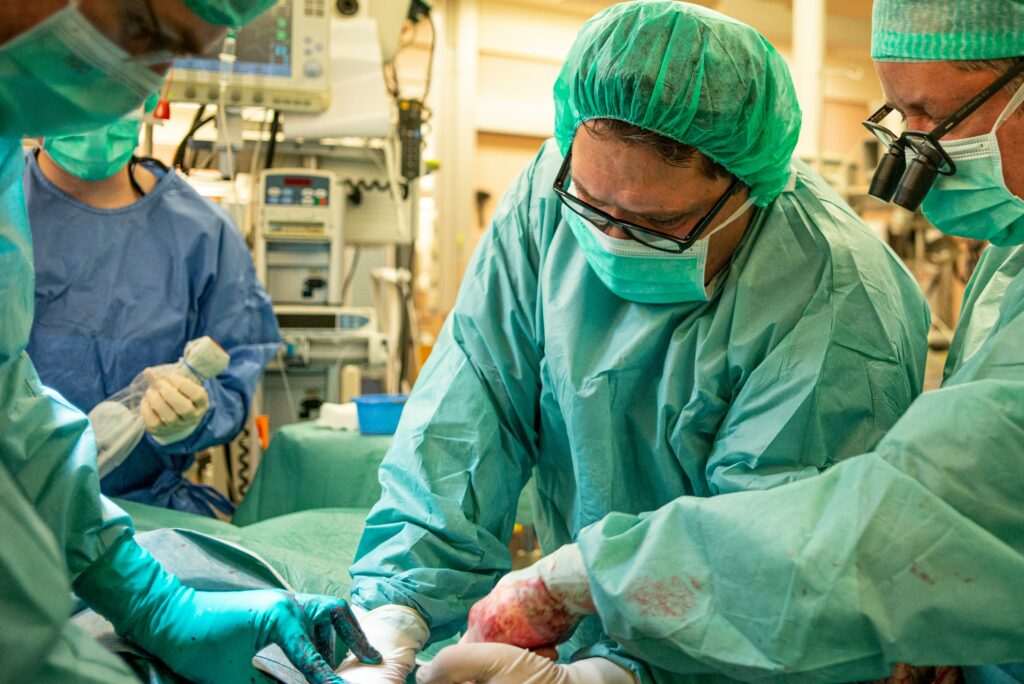
If bleeding continues, you go to the operating theatre. Mater’s patient information explains that most of the time large clots are removed, medication given and the bleeding settles, and that tears in the vagina or cervix are repaired under anaesthetic. If that fails, surgeons may place compression sutures around the uterus (such as a B-Lynch suture), tie off the uterine arteries, or arrange embolisation by a radiologist. NSW Health says the highest category of surgical urgency should be used.
When nothing else works, a hysterectomy may be needed to save your life. NSW Health says that decision should be made by an experienced consultant obstetrician, ideally with a second, and that early hysterectomy is recommended in some situations, such as placenta accreta or uterine rupture. If this happened to you, “They had to take my uterus” is written for you.
Pain relief and consent in an emergency
This is the part women most often ask me about. “Why didn’t anyone give me anything?” “Were they allowed to do that without asking?”
There are real clinical limits in a haemorrhage. Some pain-relieving drugs can lower blood pressure in a woman who is already losing blood, and there isn’t always time to wait for an anaesthetist before acting. An epidural that is still working may help; one that has worn off won’t. In a life-threatening emergency, clinicians can and must act quickly.
But the NSW Health guideline is also clear about what should happen alongside that urgency. It says that during a PPH:
What the guideline says you were owed
- You must not be left alone
- There must be regular, ongoing communication with you to reduce your stress
- Wherever possible, you should be told about interventions, their risks and benefits, and valid consent obtained, including for fundal massage and internal examinations
- The management plan should be discussed with you and, where appropriate, your partner or family
- Your support person, who may be traumatised, should be communicated with and offered a debrief
- Care of your baby must be given to an appropriate person
In plain terms: speed doesn’t cancel the need to talk to you. Even a few words (“I’m going to put my hand inside to stop the bleeding, this will hurt, I’m sorry”) are the kind of communication the guideline expects. If nobody said anything at all, that is worth raising.
From section 5.1 of the NSW Health PPH guideline (GL2025_013). Consent generally is governed by the NSW Health Consent to Medical and Healthcare Treatment Manual.
Whether pain relief should have been given, and when, is a clinical question that depends on how unstable you were, what anaesthesia was already in place, and what was available. It is a fair question to ask at a debrief, and your anaesthetic record will show what was given and when.
Step 5: Afterwards
Once the bleeding is under control, the guideline requires close observation, every few minutes at first, then every 30 minutes for at least two hours. You may have gone to recovery, a high-dependency area or intensive care. In Victoria, PPH is the leading reason new mothers are admitted to intensive care, according to Safer Care Victoria.
NSW Health also requires an assessment for blood clot risk after a severe PPH, and, for women who had severe shock or a massive haemorrhage protocol, a documented discharge and follow-up plan. Recovery is covered in “I lost over two litres”.
Memory and shock
Mater’s information notes that shock often limits a mother’s memory of what happened, and that support people are usually more affected because they saw the whole thing. If you remember fragments (shoes, lights, a sentence) and nothing between them, that is very common. My article I don’t remember my baby’s birth explores this. Your partner’s memories may fill gaps; they may also be painful for them to share. “He was left holding our baby in the corner” is for them.
What to look for in the records
Your records can tell you, often minute by minute, what was done to you and when. Ask for the complete file; my guide to getting and reading your birth records explains how.
| Record | What it shows about the emergency |
|---|---|
| Blood loss record | Whether loss was weighed and added up as it happened, and the times it passed 500 and 1,000 mL. |
| Standard Maternity Observation Chart | Pulse, blood pressure and other observations through the emergency, and whether they entered the zones that require a call for help. |
| Emergency response records | When the rapid response or emergency call was made, who came and when, and when a consultant arrived. |
| Medication chart | Each drug, dose and time. Gaps between drugs, or drugs given out of the expected order, can matter. |
| Midwifery and medical notes | Who did what: fundal massage, bimanual compression, manual removal, balloon insertion, and any note of what you were told. |
| Massive haemorrhage protocol and transfusion records | When blood was ordered, when it arrived, and what you received. |
| Anaesthetic record | What pain relief or anaesthesia you had and when. |
| Consent forms | Whether a consent form was signed for theatre or a hysterectomy, by whom, and when. |
| Operation report | What was found and done in theatre, and the total blood loss. |
If the notes say nothing at all about what you were told, that absence is itself information.
Fourteen months later I read the notes from that hour. It took me three goes. The first two times I got to the page with the times on it and had to put it down.
It was all there. 04:12 fundal massage, uterus boggy. 04:15 oxytocin. 04:19 ergometrine. 04:26 “bimanual compression, clots ++ removed.” 04:31 registrar called. 04:40 tranexamic acid. Then theatre. In between, in the midwife’s writing: “Woman distressed. Partner present.”
That was all it said about me. Woman distressed.
But I understood something else too. Reading the times, I could see how fast they were going, how many things they were doing at once. The arm wasn’t cruelty. It was a squeeze, to stop me dying. I still think someone should have told me. I think I could have borne it better if someone had said one sentence. But I stopped thinking I’d been punished for something. I took the notes to my psychologist and we read the times together.
A composite story, drawn from the experiences of many families I have worked with, combined and changed so that no one can be identified. It does not describe any individual client.
How the law looks at it
Most of the treatments in this article are standard, recognised steps. Their use isn’t negligent in itself. The legal questions usually lie elsewhere.
Standard of care
Under section 5O of the Civil Liability Act 2002 (NSW), a health professional isn’t negligent if they acted in a way widely accepted in Australia by peer professional opinion as competent practice, unless that opinion is irrational. Guidelines are evidence of that practice, not the law itself. The questions an expert will ask are often about timing and escalation: was blood loss measured; was the doctor called at 500 mL; how long before the next drug, the consultant, the balloon, the theatre; was a tear looked for when the uterus was contracted but bleeding continued?
Causation
You have to show, more likely than not, that proper care would have made a real difference. In Tabet v Gett [2010] HCA 12, the High Court confirmed that losing only a chance isn’t enough. In a haemorrhage, delay often translates into more blood lost, more transfusion, and sometimes the difference between keeping and losing the uterus.
Consent and communication
Under Rogers v Whitaker [1992] HCA 58, patients are entitled to be told of material risks. In a true emergency, there may be no time for a full discussion, and life-saving treatment can proceed. But where you were awake and able to understand, the NSW guideline expects you to be told what is happening and, wherever possible, asked. A failure to communicate may not on its own found a claim, but it can contribute to psychological injury and is a proper subject for a complaint.
Time limits
Claims in NSW generally must be started within three years of when you knew, or ought to have known, enough to claim, and within twelve years of the birth. If your baby was also injured, don’t assume their claim can wait until they turn 18. Read “Is it too late?” and medical negligence time limits in NSW.
In my practice
When I read the minutes of a haemorrhage, I am usually not looking for a wrong treatment. I am looking at the spaces between treatments. A first drug given promptly, then twelve minutes before the second. A registrar called, then forty minutes before a consultant. A balloon considered, then not inserted until after a second litre was lost. A uterus noted as firm while bleeding continued, and no one looking for a tear until theatre. These gaps are where the chain of small failures sits, and where my doctoral research focused. They are also where women’s memories of “nobody explaining” tend to cluster, because the moments of most confusion in the room are often the moments of most delay.
Holding two truths
The people who pressed on your stomach and put their hands inside you may well have saved your life. And you may have been frightened, in pain and unspoken to in a way that left a wound of its own. Both are true. You don’t have to choose between gratitude and grief, or between understanding why it was done and wishing it had been done differently.
The bigger picture
NSW Health’s 2025 guideline explicitly describes PPH as potentially traumatic for women, families and clinicians, and builds in trauma-informed care, consent and communication requirements that weren’t spelled out in older versions. Safer Care Victoria’s PPH collaborative worked on earlier recognition and measured blood loss across Victorian hospitals. The NSW Birth Trauma inquiry heard from many women about procedures done without explanation or consent during emergencies. If you want the hospital to know how it felt, a complaint is one way to tell them; my guide on making a complaint after a traumatic birth includes a template, and the Health Care Complaints Commission handles complaints about NSW health services.
Support
- PANDA National Helpline: 1300 726 306. Support for parents, including partners.
- Gidget Foundation Australia: 1300 851 758. Free psychological sessions, including after birth trauma.
- Pregnancy, Birth and Baby: 1800 882 436. Maternal child health nurses, 7am to midnight.
- Birth Trauma Australia: online peer support for mothers and partners.
- Health Care Complaints Commission (NSW): 1800 043 159.
- Lifeline: 13 11 14, 24 hours. In an emergency, call 000.
If the memories keep coming back, “I still wake up back in that room” may help, along with finding support after birth trauma in Australia. To ask the hospital your questions directly, see how to ask for a birth debrief.
The woman who read the times three times still has the photocopy. She has written one line in the margin beside “Woman distressed”, in pencil: She was scared, and she was right to be.
With care, Rosemary
Frequently asked questions
Why did they push so hard on my stomach after birth?
That was fundal (uterine) massage, used to make the uterus contract and push out clots. It is painful but is a standard first step in treating a postpartum haemorrhage.
Why did the doctor put their arm inside me?
Usually to squeeze the uterus between two hands (bimanual compression), or to remove retained placenta or clots. Both are recognised treatments when bleeding continues.
What is a Bakri balloon or JADA device?
A Bakri balloon is filled inside the uterus to press on the bleeding surface. JADA uses gentle suction to draw the uterine walls together. Both are used when drugs and massage haven’t worked.
Should I have been given pain relief during my PPH?
It depends on how unstable you were and what anaesthesia was already in place. NSW Health expects you to be told what is happening and asked wherever possible. Your anaesthetic record shows what was given.
Is manual removal of the placenta done without anaesthetic?
Removal of a retained placenta is usually done under an epidural or general anaesthetic in theatre. In a fast bleed, clots may be cleared by hand in the birth room first.
Why can’t I remember my haemorrhage clearly?
Shock and blood loss commonly affect memory. Many women remember fragments. Your records and your support person can help fill gaps when you are ready.
Questions about what was done to you?
When you’re ready, and not before, I can go through your records with you, minute by minute. A free case review means I listen, read the times in order, and tell you honestly what I see, with no obligation.
The series: After a postpartum haemorrhage
- “I Thought I Was Going to Die”: Postpartum Haemorrhage (PPH), What Happened and What You Can Do
- “Is It Too Late?” PPH: Time Limits and What a Claim Can Cover
- “Nobody Ever Told Me Why”: Why Did I Bleed So Much?
- “Their Arm Was Inside Me and No One Explained”: What Happens During a PPH (you are here)
- “I Lost Over Two Litres”: Recovery, Anaemia and Milk Supply After a PPH
- “I Passed a Clot the Size of a Golf Ball”: Secondary PPH and Retained Placenta
- “I Kept Telling Them Something Was Wrong”: When PPH Care Falls Short
- “He Was Left Holding Our Baby in the Corner”: When Your Family Saw the Haemorrhage
- “I Still Wake Up Back in That Room”: PTSD After a PPH
- “Can It Happen Again?” Pregnancy and Birth After a PPH
- “They Had to Take My Uterus”: Emergency Hysterectomy After Birth
This series is part of my work on birth trauma and obstetric negligence. If your emergency happened during a caesarean, see “I felt my C-section” and “I can’t get over my emergency C-section”.
References
- NSW Health. Postpartum Haemorrhage, Guideline GL2025_013, sections 4–7 and Appendices 11.2–11.3. August 2025.
- RANZCOG. Management of Postpartum Haemorrhage (C-Obs 43).
- Mater. Postpartum haemorrhage: patient information.
- Pregnancy, Birth and Baby. Retained placenta. Reviewed May 2026.
- Shakur H et al. Antifibrinolytic drugs for treating primary postpartum haemorrhage. Cochrane Database of Systematic Reviews 2018.
- NSW Health. Consent to Medical and Healthcare Treatment Manual. 3rd edition, 2025.
- Safer Care Victoria. New hospital reporting driving targeted improvement for Victorian women and families.
- Safer Care Victoria. Postpartum Haemorrhage Collaborative: evaluation report. 2024.
- NSW Legislative Council Select Committee on Birth Trauma. Birth trauma, Report 1. May 2024.
- Civil Liability Act 2002 (NSW), s 5O.
- Tabet v Gett [2010] HCA 12.
- Rogers v Whitaker [1992] HCA 58; (1992) 175 CLR 479.
- Health Care Complaints Commission. What can I make a complaint about?
A composite story, drawn from the experiences of many families I have worked with, combined and changed so that no one can be identified. It does not describe any individual client.
About the author. Dr Rosemary Listing holds a PhD in Law from the Australian National University; her doctorate examined patterns of failure in medical negligence. She has practised in medical negligence since 2013, is Of Counsel at Peter Evans & Associates in Newcastle, NSW, and teaches health law at the University of Newcastle. She is not medically qualified.
Last updated: 1 November 2026 · First published: 1 November 2026 · Next review: May 2027
Cite this article: Listing, R. “Their Arm Was Inside Me and No One Explained”: What Happens During a Postpartum Haemorrhage. Reframe Legal, 1 November 2026. https://reframelegal.com/what-happens-during-a-postpartum-haemorrhage/
This article is general information, not legal or medical advice. If you are worried about bleeding or your health, contact your doctor, midwife or hospital. In an emergency call 000. For crisis support call Lifeline on 13 11 14.
Legal services are provided by Peter Evans & Associates.