
Case analysis
On 8 October 2026, the Supreme Court of New South Wales dismissed every claim in Zvicer v Hunter New England Local Health District. A woman who lost her leg to overwhelming sepsis, and her four children, recovered nothing. Dr Rosemary Listing examines why, and what the judgment teaches about how these cases are won and lost.
- Case
- Zvicer v Hunter New England Local Health District [2026] NSWSC 1241
- Court
- Supreme Court of New South Wales, Common Law Division
- Judge
- Muston J
- Decision
- 8 October 2026. All claims dismissed, with costs.
- At stake
- Agreed damages of $1,174,971.94 had the claim succeeded.
What happened
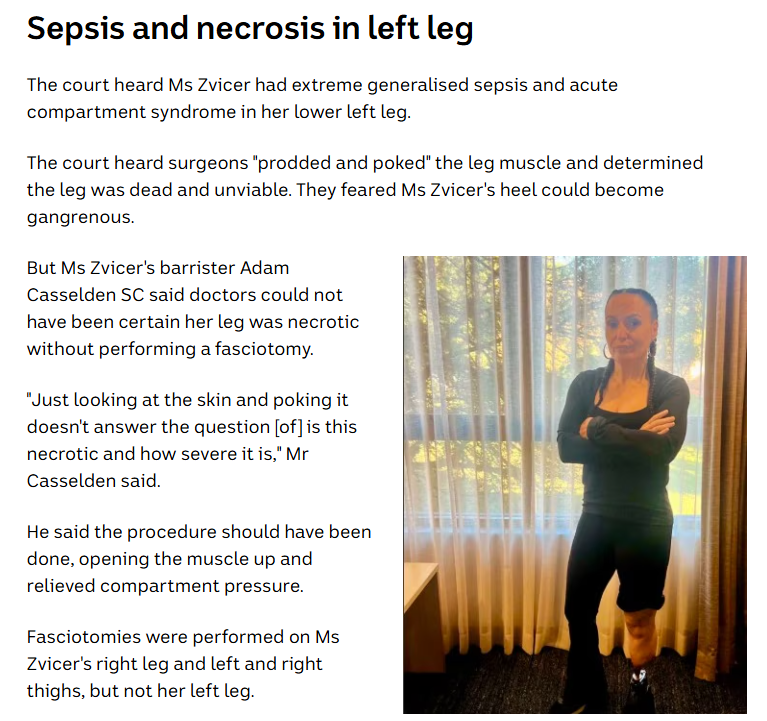
In the early hours of 11 November 2020, Vesna Zvicer, then 41, was rushed to John Hunter Hospital with overwhelming streptococcal sepsis. The infection set off acute compartment syndrome in both of her legs and both thighs. On the morning of her admission, an orthopaedic surgeon, with a second opinion from the hospital's director of trauma services, performed fasciotomies on her right leg and both thighs. They did not perform one on her left leg. Having examined it and found no pain response, they concluded that the muscle in the left leg was, in the words recorded in the notes, "likely dead" and could not be saved. Ms Zvicer's left leg was later amputated below the knee in January 2021.
Ms Zvicer alleged that the failure to perform a fasciotomy on her left leg on 11 November 2020 caused, or materially contributed to, the amputation. Her four children each claimed to have suffered psychiatric injury arising from their mother's illness and its consequences.
What the plaintiffs had to prove
A claim of this kind in New South Wales runs a gauntlet of statutory hurdles under the Civil Liability Act 2002, and the plaintiff carries the onus at each one. Three mattered most here.
The first was breach. Ordinarily a plaintiff asks whether a reasonable practitioner would have taken the precaution that was missed. But the hospital invoked section 5O, the peer professional opinion defence. That changes the question entirely. The issue became whether the decision not to perform the fasciotomy was something that would not be widely accepted in Australia, by peer professional opinion, as competent professional practice.
The second was causation, under sections 5D and 5E. Even if the decision was a breach, Ms Zvicer still had to prove that performing the fasciotomy would have avoided the below knee amputation, or at least led to a materially less severe one.
The third applied to the children. They had to establish that a duty was owed to them, that it was breached, and that the negligence, rather than the wider ordeal of their mother's illness, caused a recognised psychiatric illness.
Why the claims failed
Breach: section 5O did its work
The hospital called two experts who considered that the decision not to perform the fasciotomy accorded with competent professional practice, and who said they would have made the same decision. The plaintiffs called two experts who would have performed the fasciotomy. Critically, one of the plaintiffs' own experts accepted that the decision was one on which, in his words, "reasonable minds may differ". Once that concession was made, the peer opinion defence was close to unanswerable. The court held that the surgeon had acted in a manner that would have been widely accepted by peer professional opinion as competent practice. Breach was not established.
In a section 5O case, the moment a plaintiff's own expert accepts that reasonable practitioners could have made the same decision, the defence is all but complete.
Causation: the leg was likely gone before the decision was ever made
The causation case faced two separate problems, either of which was fatal.
The first was timing. Ms Zvicer's own account pointed to muscle death having begun before she even reached hospital. She had severe leg pain from the night before, she passed what she and her husband described as "black urine" before calling the ambulance, and her blood on arrival showed a CK level above 213,000. The experts agreed that once genuine ischaemia takes hold, roughly eight to ten hours spells the end of the muscle. The surgery took place around eight to ten hours after the ischaemia was likely to have begun. On that basis the court was not satisfied that a fasciotomy at the time of surgery would have salvaged the leg.
The second was independent causation. Even if the leg had been salvageable, the experts agreed that the sepsis, together with the drugs needed to keep Ms Zvicer alive, independently caused the tissue in her foot and heel to die. The defence experts described a below knee amputation as "always on the cards" and as "highly likely or inevitable" regardless of the fasciotomy. So the amputation was not shown to have been caused by the decision under challenge.
The children: a duty recognised, but no causation
There is an important point in the judgment for families, and it is a point in the plaintiffs' favour. The court confirmed that in Australia a hospital can owe a duty of care to a patient's children to guard against psychiatric injury, following the High Court authorities of Gifford v Strang and Tame and Annetts. In doing so it declined to follow the more restrictive 2024 decision of the United Kingdom Supreme Court in Paul v Royal Wolverhampton. That is a useful confirmation that Australian law remains more generous than English law on secondary psychiatric claims.
It did not save the children's claims. Because breach was not made out, their claims fell with their mother's. And in any event, the court found that their distress flowed from the whole ordeal, a mother taken away in the night, a long separation, seeing her gravely unwell and seeing her blackened toes, rather than specifically from the amputation. The psychiatrists could not disentangle the amputation's contribution from everything else, and the court was not satisfied that the amputation, as opposed to the tragedy as a whole, had caused the harm.
The analysis: where the case was vulnerable, and how a claim like this is best run
This was a desperately hard case on its facts, and nothing that follows is a criticism of those who ran it. A great deal of what decided the outcome was fixed long before any lawyer was involved, in the hours before Ms Zvicer reached hospital. But the judgment is close to a teaching text on where plaintiff medical negligence claims succeed and where they come apart. Six lessons stand out.
- In a section 5O case, your own experts cannot hand the defence its standard
The peer opinion defence does not require the defendant to have been right. It requires only a reasonable body of peers who would have done the same. The plaintiff's task is therefore to show that no reasonable body of peers would have accepted the decision, or that the opinion relied on was irrational under section 5O(2). An expert who concedes that reasonable minds could differ has, in substance, conceded the case. Expert selection and briefing is not preparation for the case. It is the case.
- Causation experts must commit, in writing, with reasons
The plaintiffs' causation evidence was described as guarded and qualified, expressed in words like "plausible", "some portion", and "cannot be stated with certainty". An attempt to firm that up to "more likely than not" in the witness box, after the written report had hedged, did not persuade. A causation opinion that does not commit on paper rarely commits at trial.
- Make the pivotal question objective wherever you can
The viability of the left leg was the whole case, and it was fought as a retrospective contest of opinion years after the event. Yet an on table angiogram had been offered on the day and was not done, and later imaging showed the main vessels were patent. Where an objective, contemporaneous assessment of the very thing in dispute was available and omitted, that is the ground on which to build, ideally with evidence from the clinicians who offered it.
- Build the evidence you need, do not ask the court to infer it
The plaintiffs asked the court to draw an inference against the hospital for not calling several of the clinicians involved. The court declined, noting that their contemporaneous notes were already in evidence and, pointedly, that the plaintiffs could themselves have called or subpoenaed them. Inference and cross examination are no substitute for affirmative evidence on the issues a plaintiff must positively prove.
- Plead the loss you can actually prove
An all or nothing case, that the amputation would have been avoided entirely, was exposed by the independent pathway to necrosis. The difficulty is that Australian law, under Tabet v Gett, does not allow recovery for the mere loss of a chance of a better outcome. That is precisely why the causation evidence has to reach "more likely than not", and why a realistic, provable formulation of the loss has to be settled early, not reached for at trial.
- Secondary psychiatric claims rise and fall on two things
They need the primary claim to succeed, and they need the specific negligent outcome, rather than the underlying tragedy, to be the cause of the psychiatric harm. Where a parent was gravely ill regardless of any negligence, disentangling the two is hard, and it has to be confronted directly in the psychiatric evidence rather than assumed.
What it means for patients and families
Medical negligence claims are not lost because the harm was not real. Ms Zvicer lost her leg, and her family lived through something no family should have to. These cases turn on two unforgiving questions. Would competent care have been different, and would it have changed the outcome. The timing of what happened, and the quality of the evidence available to prove it, often matter more than the severity of the injury itself. That is why early and rigorous assessment matters so much, before memories settle and before the evidentiary trail goes cold.
This article is general information and legal commentary on a public judgment. It is not legal or medical advice, and it does not create a lawyer and client relationship. The clinical findings described are those made by the court on the expert evidence before it. The court found that the treating clinicians acted within competent professional practice.
Source: Zvicer v Hunter New England Local Health District [2026] NSWSC 1241, Supreme Court of New South Wales, published at caselaw.nsw.gov.au.
Worried about care you or a family member received?
Dr Rosemary Listing acts for patients across Australia harmed by negligent medical care. A free, confidential clarity call is the simplest way to understand where you stand.
Book a free clarity call